
9 Local Listing Management Moves That Win More Calls
Last updated November 11, 2026
Local listing management is the systematic maintenance of your business's name, address, phone number, hours, and other details across Google, directories, and AI platforms. The nine moves below come from analyzing 86 Google Business Profile training videos and building optimization workflows inside Launch CRM. Each one improves how customers find and call you.
Table of contents
- 1. Consistent name, address, and phone number across all online listings is the foundation of local listing management
- 2. Beyond basic NAP, optimize your Google Business Profile with rich details, photos, and regular posts to attract more customers
- 3. Leverage customer reviews by actively requesting them and responding to all feedback to build trust and improve your local ranking
- 4. Expand your online presence by listing your business on a broad range of general and industry specific directories
- 5. Align your website's content and structure with your Google Business Profile to strengthen your local search relevance
- 6. Stay current with AI driven search trends, as accurate and consistent listings are key for visibility on new platforms
- 7. Proactively manage your business's online reputation by addressing negative feedback and consistently generating new positive reviews
- 8. Capture leads effectively by integrating your Google Business Profile with a robust CRM system for call and message management
- 9. Simplify management of multiple business locations by using a centralized platform for updates
- How to Act on These 9 Local Listing Management Moves
- What to Avoid in Local Listing Management
- Measuring the Impact of Local Listing Management
- Frequently asked questions
1. Consistent name, address, and phone number across all online listings is the foundation of local listing management
NAP consistency means ensuring your business name, address, and phone number are identical on your Google Business Profile, website, Facebook, Bing, Yelp, and every other directory where your business appears. Inconsistent NAP information confuses search engines and splits the ranking signal that should flow to a single business entity. Makes it harder to appear in the Google Maps top 3.
When your address is 123 Main St on Google but 123 Main Street on Yelp (or Suite B is included on Facebook but not elsewhere), Google can't confidently match all those citations to one business. This weakens your local pack ranking. Make a change once and push it everywhere. Your hours, address, and phone number stay correct when a customer looks you up on any platform. We start every engagement by auditing NAP across the top 30 directories and your website's LocalBusiness schema to identify and fix mismatches that are leaking ranking power. Marketing 360 found that accurate, consistent listings help businesses show up on AI powered platforms, not just traditional search engines. Fixing NAP strengthens your presence everywhere customers look.
2. Beyond basic NAP, optimize your Google Business Profile with rich details, photos, and regular posts to attract more customers
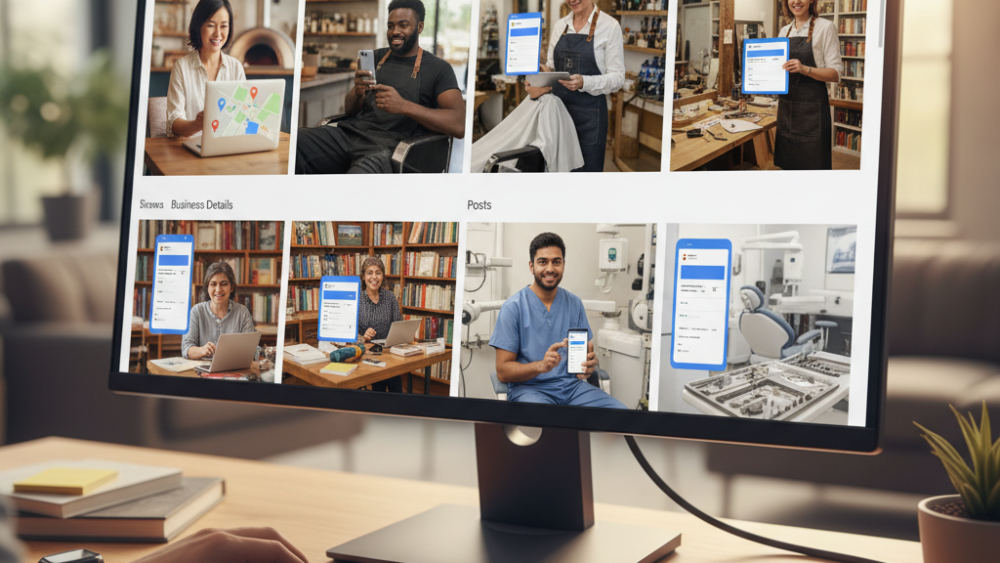
Add a compelling 750 character business description, list all your services with descriptions, accurately set your hours including special hours, and include attributes that highlight your unique offerings like wheelchair accessibility or online estimates. Upload about 15 high quality photos per month dripped over time, showcasing your team at work, completed projects, your branded vehicle, and happy customers. Visuals directly impact how often people call or request directions.
Post weekly updates on your Google Business Profile (ideally every one to two days) about offers, events, or news, with real photos and a Book or Call button. Keeps your profile active and engaging. A service area plumber in Vista noticed steadier phone traffic after moving from monthly to every other day posting. Each post highlighted a recent job and a clear call. Inside Launch CRM, use Reputation then GBP Optimization to manage all these fields in one place. Marketing then Social Planner lets you schedule Google posts in advance so you stay consistent even during busy weeks.
3. Leverage customer reviews by actively requesting them and responding to all feedback to build trust and improve your local ranking
Implement a system for requesting reviews from happy customers at the happiest moment of service, using compliant methods like text or email. Sending two to five review requests per day for past customers maintains steady velocity. Respond to every review (positive or negative) within 24 to 48 hours to show customers you value their feedback and are engaged. This also signals to Google that the profile is actively managed. Reviews are a major factor in local search ranking and provide social proof before a customer calls. Many businesses see the most lift when they go from sporadic reviews to a steady monthly cadence.
We set up compliant review request flows by text and email inside Launch CRM, with automated triggers tied to job completion. We never use review gating or ask customers to revise negative feedback privately before posting. Marketing 360 emphasizes that consistent review generation (not just a high total count) gives search engines confidence that your business is active and customers are satisfied right now.
4. Expand your online presence by listing your business on a broad range of general and industry specific directories
Beyond Google Business Profile, ensure your business is accurately listed on Bing Places, Facebook business pages, Yelp, the Better Business Bureau, and other prominent general directories where customers search. Seek out industry specific directories and apps where your target customers might be searching, such as Houzz for remodelers, Healthgrades for medical practices, or Angi for home services. Each citation reinforces your legitimacy.
More listings mean more opportunities for customers to find you and provide additional signals to search engines about your business's existence, especially when NAP is consistent across all of them. We build and maintain citations on the top 30 directories as part of our local SEO website alignment work, ensuring every listing matches the Google Business Profile exactly. General directories cast a wide net. Industry specific ones deliver higher intent leads who are already looking for what you do. A balanced mix of both gives you coverage and relevance in every corner where your next customer might start their search.
5. Align your website's content and structure with your Google Business Profile to strengthen your local search relevance
Ensure your homepage title tag, meta description, and H1 heading use the same primary keyword and target cities that appear in your Google Business Profile primary category and service area. Implement LocalBusiness schema markup on your website to provide structured data to search engines about your business name, address, phone number, hours, and service area in a machine readable format. Create local FAQs on your website that answer common questions customers have about your services in your specific service areas, using the same language and city names as your Google Business Profile.
We help businesses align their website's homepage title, meta description, H1, LocalBusiness schema, and FAQs with their GBP keywords and cities for enhanced local SEO. Treat the website and the profile as two parts of one ranking entity. When a pest control company in Escondido matched their homepage title and schema to the exact categories and cities in their Google Business Profile, they saw clearer search visibility within weeks. Google could finally see one cohesive signal instead of two competing ones.
6. Stay current with AI driven search trends, as accurate and consistent listings are key for visibility on new platforms
AI driven search refers to search technologies powered by artificial intelligence, including conversational AI platforms like ChatGPT, Gemini, and Perplexity that answer questions by pulling data from the web. Accurate, consistent listings help your business show up when customers use AI powered platforms to ask questions like where to find a plumber near me or what roofer in my area has the best reviews. Not just when they type into Google. As AI tools integrate live search capabilities, having well optimized listings with complete NAP, reviews, photos, and schema ensures your business is discoverable in these new contexts.
The fundamental principles of local listing management (like NAP consistency and complete profiles) remain crucial even as search technology evolves. AI pulls from the same directories and structured data that Google does. Marketing 360 notes that businesses with accurate listings benefit from AI powered search results. Any investment you make in citation quality today pays dividends across every platform your customers will use tomorrow.
7. Proactively manage your business's online reputation by addressing negative feedback and consistently generating new positive reviews
Monitor your reviews across Google, Facebook, Yelp, and industry directories. Address any negative feedback constructively and promptly, offering to resolve the issue offline if appropriate. A steady stream of positive reviews (requested compliantly at the right moment) helps to offset occasional negative ones and presents a balanced, trustworthy image of your business to prospective customers. Reputation management isn't just about reviews. It also involves managing your overall online presence, ensuring the first page of Google results for your business name shows accurate, positive information.
Our approach focuses on compliant review requests by text and email, ensuring steady review velocity and never using review gating. You build a natural review profile that Google trusts. A contractor who implemented weekly review requests and responded to every piece of feedback within 24 hours saw their average rating climb from 4.2 to 4.7 stars over four months. This moved them from position five to position two in the local pack for their primary keyword.
8. Capture leads effectively by integrating your Google Business Profile with a robust CRM system for call and message management
Use a tracked phone number on your Google Business Profile to monitor every call source, duration, and outcome. Integrate those calls directly into your CRM so no lead falls through the cracks. Ensure all Google Business Profile messages arrive in a unified inbox alongside calls, texts, and emails, allowing for quick responses and automated follow ups within minutes of a customer reaching out. Automate welcome texts, missed call text back, and follow up sequences for new leads from Google Maps to improve conversion rates and streamline your sales process. Turn profile views into booked appointments.
We integrate Google calls and messages directly into Launch CRM (built on HighLevel) to turn leads into booked jobs with automated follow ups. Use Settings, Phone System, Missed Call Text Back and the unified inbox in Conversations. A plumber who connected their Google Business Profile to this workflow saw their call to booking rate jump from 22 percent to 41 percent in the first 60 days. Simply because no lead went unanswered longer than five minutes.
9. Simplify management of multiple business locations by using a centralized platform for updates
If you operate multiple branches or service areas, a single dashboard lets you update hours, services, photos, and posts once and push the changes to all locations. Saves hours per week and reduces the risk of inconsistencies. Centralized management ensures all customer facing information (holiday hours, new services, emergency contact numbers) is uniform for every location. This strengthens trust and brand consistency. Track performance separately for each location with geo grid rank tracking and monthly benchmarking against the top 3 competitors within a realistic 30 to 40 minute service radius to measure which locations need more attention.
We offer geo grid rank tracking and monthly benchmarking against top 3 competitors within a realistic 30 to 40 minute service radius to measure performance. Multi location businesses know exactly where each branch stands in the local pack. Marketing 360 provides centralized dashboards that push updates to multiple directories at once. Necessary for any business managing three or more physical locations.
How to Act on These 9 Local Listing Management Moves
Start by auditing your current Google Business Profile and top 10 directories for NAP mismatches, incomplete fields, missing photos, and stale posts. Use a spreadsheet to track what needs fixing on each platform. Prioritize the fixes by impact: NAP consistency and primary category first, then complete services and attributes, then photos and posts, then citations and website schema. Set a sustainable cadence for ongoing management: about 15 photos per month dripped over time, one Google post every one to two days, two to five review requests per day, and a monthly audit of your top directories.
Our free Google Business Profile audit identifies critical issues and ranks fixes by impact, guiding you directly to what will make the most difference in your local pack visibility. Automate as much as you can inside a CRM like Launch CRM. Review requests, post scheduling, and lead follow ups happen consistently without manual work every day. For businesses that want to streamline operations across multiple channels, exploring options like Launch AI Academy can help you build integrated workflows that turn visibility into revenue.
What to Avoid in Local Listing Management
Never add keywords to your business name on Google Business Profile, use a PO box or virtual office address, or set up duplicate listings for the same location. These are policy violations that trigger suspensions. Avoid review gating, which means filtering customers and only asking happy ones to leave a Google review while steering unhappy ones to private feedback. Google explicitly prohibits this practice. Don't bulk upload 50 or 100 photos at once, change your primary category frequently, or post multiple times per day in bursts after weeks of silence. Sudden spikes look unnatural and can hurt rather than help.
Never offer incentives for reviews, ask employees or friends to leave fake reviews, or pay for reviews. These tactics violate Google's guidelines and put your entire profile at risk of permanent removal. Set honest timelines and expectations: it takes about 90 days to recalibrate after making major changes, and months four to six to see meaningful ranking movement. Don't expect overnight jumps or guaranteed number one positions. Many businesses get suspended because they chase shortcuts instead of building a sustainable, compliant foundation that delivers results over time.
Measuring the Impact of Local Listing Management
Track your Google Business Profile insights weekly, focusing on discovery searches (how often you appear in search results), direct searches (branded searches for your business name), and actions (calls, direction requests, website clicks, and bookings). Use geo grid rank tracking to monitor your position in Google Maps for your top three to five target keywords across a grid of locations within your service area. Measure movement every seven to 14 days. Benchmark your performance monthly against the top 3 competitors in your category and service area, comparing review count, review velocity, photo count, post frequency, and average star rating.
Monitor call volume, call source, and conversion rate from Google Business Profile calls and messages inside your CRM. You'll know exactly how many leads turn into booked jobs and which tactics drive the most revenue. Set clear goals for each 90 day period, such as adding 25 new reviews, publishing 60 Google posts, uploading 45 photos, and moving from position 7 to position 4 in the local pack for your primary keyword. If you're not seeing progress after 90 days of consistent work, request a fresh audit to identify what's holding you back. Whether it's a category mismatch, a suspension risk, or a competitor that has pulled ahead in one specific area.
Frequently asked questions

What is local listing management?
Local listing management is the systematic process of maintaining accurate, consistent business information across Google Business Profile, directories, social platforms, and AI search tools to improve local search visibility and customer trust. It involves managing your name, address, phone number, hours, services, photos, reviews, and posts on every platform where customers might find you. Effective local listing management ensures that when someone searches for your type of business on Google Maps, Bing, Facebook, or asks an AI assistant, your business appears with correct, up to date details.
How do businesses keep their listings consistent across directories?
Businesses keep listings consistent by auditing their NAP (name, address, phone number) across the top 30 directories, making corrections wherever discrepancies appear, and using a centralized platform or spreadsheet to push updates to all platforms at once. Many use a local listing management service or tool that syncs changes from one dashboard to Google, Bing, Facebook, Yelp, and other directories automatically. The key is updating information in one authoritative place first (usually Google Business Profile), then mirroring that exact wording, format, and punctuation everywhere else.
Why does NAP consistency matter for local search?
NAP consistency matters because search engines use citations (mentions of your business's name, address, and phone number on other websites) to validate your business's existence and location. Inconsistent NAP splits that validation signal across multiple entities. When your address is 123 Main St on Google but 123 Main Street on Yelp and Suite B is included on Facebook but not elsewhere, Google can't confidently match all those citations to one business. This weakens your local pack ranking. Consistent NAP across your website, Google Business Profile, and at least 10 to 20 major directories signals to search engines that your business is legitimate, stable, and trustworthy.
What are the most important elements of local listing management?
The most important elements are NAP consistency across all platforms, a fully optimized Google Business Profile with correct categories and complete services, a steady flow of customer reviews with replies, regular photo and post updates, and citations on general and industry specific directories. Website alignment (meaning your homepage title, meta description, H1, and LocalBusiness schema match your Google Business Profile keywords and service areas) is also critical for ranking. Lead capture integration turns visibility into revenue by ensuring calls and messages from Google Business Profile flow into a CRM for fast follow up.
How does local listing management impact search engine optimization?
Local listing management directly impacts SEO by building citations that validate your business to search engines, improving your Google Business Profile's relevance and prominence signals, and aligning your website's structured data with your profile. Strong local listing management increases the likelihood that your business appears in the local pack (the block of three local business listings at the top of Google search results), which captures the majority of clicks for local intent searches. It also ensures your business is discoverable on AI driven search platforms like ChatGPT and Gemini, which pull business information from directories and structured data when answering local queries.
What tools are available for managing local business listings?
Local listing management tools range from Google's own Google Business Profile dashboard (free and manages your Google presence) to platforms like Launch CRM (built on HighLevel) that integrate GBP management, review requests, post scheduling, and lead capture in one system. Other services, such as Marketing 360, offer centralized dashboards that push updates to multiple directories at once. Saves time for businesses with multiple locations. The best tool depends on your needs: free tools work for single location businesses willing to manage manually, while integrated CRM platforms are better for businesses that want automation, lead follow up, and performance tracking in one place.
How do I update my business information across many directories at once?
You can update information across many directories at once by using a local listing management service that syncs changes from one dashboard to Google, Bing, Facebook, Yelp, and other platforms automatically. Alternatively, manually update your Google Business Profile first, then visit each major directory (Bing Places, Facebook business page, Yelp, BBB, Angi, industry directories) and copy the exact NAP, hours, and description from Google to ensure consistency. For businesses with multiple locations, a centralized platform is essential to avoid inconsistencies and save hours per week.
What is the difference between general and industry-specific directories?
General directories like Google Business Profile, Bing Places, Facebook, and Yelp list businesses across all industries and are essential for baseline visibility. Industry specific directories (such as Houzz for home remodelers, Healthgrades for medical practices, or Angi for home services) target a narrower audience actively searching for that type of business. Often deliver higher intent leads. A strong local listing strategy includes both: general directories for broad reach and foundational citations, plus three to five industry directories where your ideal customers are most likely to search.
Can local listing management help improve my customer reviews?
Yes, local listing management improves reviews by implementing a consistent system for requesting feedback from happy customers at the right moment. Uses compliant text or email requests sent through a CRM. It also ensures you respond to every review promptly, which encourages more customers to leave feedback because they see you're engaged and value their input. A steady review velocity (such as 8 to 12 new reviews per month) built through compliant requests over time is far more effective than sporadic bursts or bulk requests that look unnatural to Google.
How often should I audit my business's online listings?
Audit your business's online listings at least once per quarter (every 90 days) to catch discrepancies, outdated hours, duplicate listings, or new directories where your competitors appear but you don't. Run a more focused audit of your Google Business Profile weekly, checking for new reviews to reply to, photos to upload, posts to publish, and questions to answer. If you make a significant change (new address, phone number, or primary category), audit all listings immediately and push the update everywhere within 24 to 48 hours.
What if my business has multiple locations?
If your business has multiple locations, create a separate Google Business Profile for each physical location with its own unique address, phone number, and landing page. Manage them through the Google Business Profile dashboard or a centralized platform. Ensure NAP is consistent for each location across its own set of citations. Avoid using the same phone number or landing page URL for multiple profiles, as this can confuse search engines and dilute ranking signals. Use geo grid rank tracking and monthly benchmarking for each location individually to identify which branches need more attention. Consider location specific review request campaigns to build social proof evenly.
Does local listing management affect my website's SEO?
Yes, local listing management affects your website's SEO by building citations that signal your business's legitimacy to search engines. Can improve your organic rankings for local keywords. When your website's LocalBusiness schema, homepage title, meta description, and H1 match the NAP and keywords on your Google Business Profile and citations, search engines see one cohesive entity. This strengthens both your profile and website rankings. Consistent listings also reduce confusion, so link equity and ranking signals flow to the correct website URL rather than being split across multiple domains or variations of your business name.
Local listing management is not a one time project but an ongoing process that builds momentum over months. The businesses that win in local search are the ones that commit to consistency, measure their progress against competitors, and adjust their tactics based on real data. Start with the fundamentals, automate what you can, and watch your phone ring more often. Get your free audit to see exactly where your business stands today and what to fix first for the biggest impact on your local pack visibility.

