
White Label SEO Report for Local Agencies and Businesses
Last updated November 6, 2026
A white label SEO report for local businesses focuses on Google Business Profile performance, technical website health, on-page optimization, backlink analysis and keyword rankings, all rebranded under your agency's name. The most valuable white label reports include Google Maps position tracking, review velocity, photo and post cadence, and prioritized fixes ranked by impact so clients know exactly what to do next.
Table of contents
- Key takeaways
- What a White Label SEO Audit Covers for Local Businesses
- Why Local SEO Reports Need Google Business Profile Data
- Essential Sections Every White Label Local SEO Report Must Include
- How to Structure Data So Clients Know What to Do Next
- White Label Tools Compared: General SEO vs Local SEO Focus
- Comparison of White Label Report Focus Areas
- How to Rebrand and Customize Reports for Your Agency
- When a White Label Report Reveals Serious Issues
- Using White Label Reports to Retain and Upsell Clients
- Why Isn't My Business Showing Up in the Google Maps Top 3?
- What Is the Best Primary Category for My Google Business Profile?
- How Do I Get More Google Reviews Without Breaking Google's Rules?
- How Often Should I Post on My Google Business Profile, and What Should I Post?
- Why Was My Google Business Profile Suspended and How Do I Get It Back?
- How Do I Verify My Google Business Profile With a Video?
- Can a Service Area Business With No Storefront Rank in Google Maps?
- How Do I Get More Phone Calls and Booked Jobs From My Google Business Profile?
- Frequently Asked Questions
- Turn Audit Data Into Client Results
Key takeaways
- White label local SEO reports let agencies rebrand Google Business Profile and Maps data under their own logo and present it to clients.
- Essential report sections include GBP completeness, local pack ranking, review velocity, post and photo cadence, technical SEO and on-page structure.
- Actionable recommendations ranked by impact convert raw data into clear next steps clients can follow.
- Most tools cover general SEO, but few specialize in Google Business Profile metrics like categories, services, Q&A and suspension status.
- Our free Google Business Profile audit delivers a prioritized fix list and works as a ready-to-use white label report for agencies.
What a White Label SEO Audit Covers for Local Businesses
A white label SEO audit is a service or tool that allows marketing agencies to rebrand SEO analysis and reports as their own, presenting them to clients under the agency's brand without revealing the original provider. For marketing agencies building a local SEO practice, white label reporting solves two problems at once: it gives you professional deliverables to send clients, and it educates you on what matters most for local visibility.
A professional SEO audit delivers results across several dimensions including technical performance, on-page structure, off-page analysis, content and keywords, and user experience and conversion signals, according to research by Blogtec. Technical SEO ensures a website meets the technical requirements of modern search engines with the goal of improved organic rankings. It covers site speed, mobile responsiveness, crawlability, indexing and structured data. On-page SEO optimizes website elements like content, headings, title tags and images to improve search engine rankings, while off-page SEO focuses on activities done outside of a website to improve its ranking, primarily through backlinks.
For local businesses, however, a complete audit must also include Google Business Profile completeness, local pack position, review generation rate, photo and post frequency, and whether the profile is verified or suspended. That's where most general SEO tools fall short. They excel at scanning HTML and backlinks, but they don't tell you that the primary category is wrong, the business hasn't posted in six months, or review velocity is zero. Those are the signals that determine whether a roofer shows up in the Maps top three or sits invisible on page two.
Why Local SEO Reports Need Google Business Profile Data
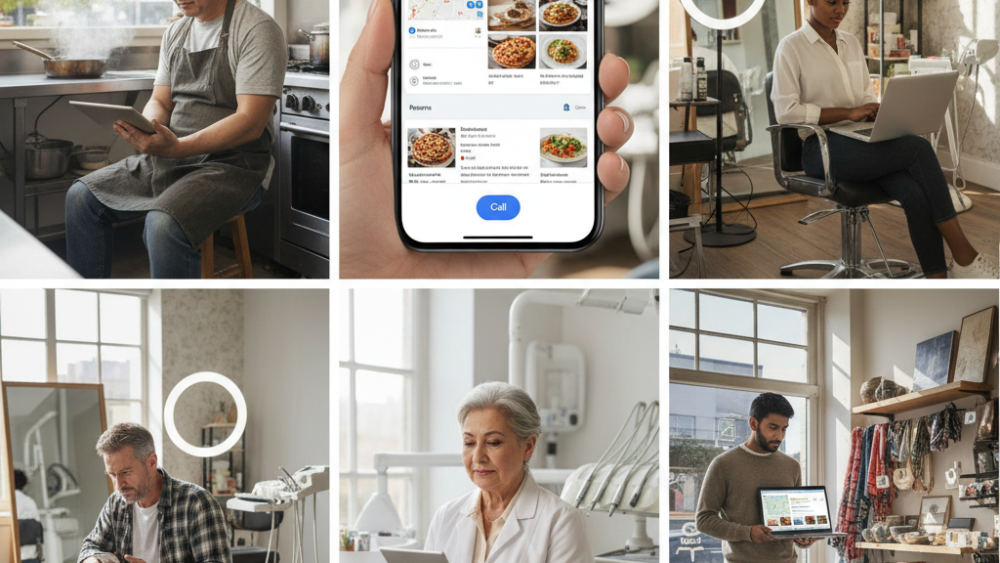
Most white label SEO reporting tools cover website metrics well but miss the core of local visibility: Google Business Profile and Google Maps rankings. Google Business Profile (GBP) is a free tool by Google that allows businesses to manage their online presence across Google Search and Google Maps. It directly controls whether a business appears in the local pack at the top of search results. The local pack is the block of three local business listings that appears at the top of Google's search results for local queries, and ranking there drives most inbound calls for service businesses.
Website SEO matters. But for plumbers, HVAC companies, roofers, pest control services and other home service businesses, the majority of calls come from the call button on the Google Business Profile, not from organic website links three positions lower. If your white label report doesn't measure GBP performance, you're reporting on the wrong thing.
A local SEO report must track GBP elements like primary and secondary categories, services, reviews and reply rates, photos, posts, Q&A, attributes and whether the profile is verified or has suspension risk. Our free Google Business Profile audit focuses specifically on local business visibility on Google Maps and local search, assessing categories, reviews, photos, posts and business info consistency, then delivering fixes ranked by impact. That's the starting point agencies can rebrand and deliver, giving clients the clarity they need without inventing data.
Essential Sections Every White Label Local SEO Report Must Include
Every white label local SEO report should open with the most critical data point: where the business stands in the local pack today for its core keywords. Then, break the rest of the report into these sections.
Business information and consistency. Exact business name, address, phone and hours matched across GBP, website, citations and directories. Inconsistent NAP (name, address, phone) confuses Google and splits ranking signals.
Google Business Profile completeness. Primary and secondary categories, 750 character description, all services with descriptions, hours, attributes, products, photos (at least 100), posts (weekly minimum), Q&A seeded, reviews and reply rate. Each blank field is a missed relevance signal.
Local pack ranking. Current position in Google Maps for the top five to ten keywords in the target service area, compared to the top three competitors. Include the date of the scan and the city center searched from, because rankings shift every few blocks.
Review generation and reputation. Total reviews, review velocity (new reviews per month), average star rating, reply rate, recent review dates and sentiment. Clients understand reviews better than algorithm updates, so this section makes the ROI tangible.
Website alignment. Homepage title, H1, meta description and LocalBusiness schema matched to GBP keywords and cities, plus mobile speed and user experience factors that impact perceived quality and search engine ranking. Google checks consistency between the profile and the linked website.
Technical SEO health. Crawl errors, indexing status, site speed, mobile responsiveness, SSL certificate, sitemap and robots.txt configuration. These are table stakes, not competitive edges, but broken technical SEO can zero out all other efforts.
Keyword rankings and organic traffic. Position tracking for target keywords in organic search, estimated monthly search volume, organic traffic trends and traffic to key landing pages. Organic rankings still matter for longer tail queries and reputation searches.
Citations and backlinks. Consistency across major directories (BBB, Yelp, Angi), domain authority, total backlinks and toxic link detection. Local citations reinforce NAP consistency, and quality backlinks still boost domain trust.
How to Structure Data So Clients Know What to Do Next
Raw data without context wastes a client's time. Every white label report must convert metrics into prioritized recommendations. We provide fixes ranked by impact in our audits, making it easy for agencies to show clients clear, actionable steps: high impact fixes first, then medium and low, with a realistic time estimate for each.
Each recommendation should state the current status, the goal, the specific action required and the expected outcome, such as "Primary category: currently General Contractor, top three competitors use Roofing Contractor. Change to Roofing Contractor in GBP settings. Expected lift: 20 to 30 percent relevance boost for roofing searches." That level of specificity converts confusion into confidence.
Practical rule: Every white label report must list fixes ranked by impact so clients know what to do first. High impact fixes always include primary category, verification status and review reply rate.
Include a 30, 60, 90 day roadmap so clients see the sequence: verify the profile and fix critical errors in month one, build review and post velocity in month two, add photos and refine categories in month three. Clients want a plan, not a pile of numbers. For agencies working inside HighLevel, show the practical path: Reputation > GBP Optimization to edit business info and categories, Reputation > Settings > Review links to send compliant review requests, Marketing > Social Planner to schedule Google posts. Those specific directions eliminate guesswork.
White Label Tools Compared: General SEO vs Local SEO Focus
White label SEO audit tools like SE Ranking, WebCEO and SEOptimer allow agencies to analyze websites, identify opportunities and present results in their own branded reports. But most emphasize website technical audits over Google Business Profile metrics, as noted by Blogtec's comparison. SE Ranking offers comprehensive website audits, keyword rank tracking and backlink analysis with white label PDF export, but minimal Google Business Profile or local pack tracking.
WebCEO provides technical, on-page and off-page audits plus citation tracking, with full white label branding, but no native Google Business Profile post or photo performance reporting. SEOptimer delivers fast, client-friendly audits with white label options. It focuses on website health, meta tags, mobile speed and social signals, but does not audit GBP categories, reviews, posts or local pack position.
For agencies focused on local and service area businesses, a white label report must include GBP-specific data: categories chosen, services listed, review velocity, photo and post frequency, Q&A status and whether the profile is verified or at risk of suspension. That's the data clients actually see when they look at their own profile, and it's the data their competitors are optimizing daily. Our approach includes integrating Google calls and messages into Launch CRM (built on HighLevel) for lead capture and follow up, turning every Maps call into a tracked lead with automatic text back and booking calendar. For agencies offering white label services, that integration becomes a revenue differentiator, not just a ranking report.
Comparison of White Label Report Focus Areas
This table shows what general SEO tools cover versus what a local SEO white label report must include for businesses that depend on Google Maps.
| Report Section | General SEO Tools | Local SEO Focus |
|---|---|---|
| Website technical audit | Yes, comprehensive | Yes, but secondary |
| On-page SEO and meta tags | Yes | Yes |
| Backlink analysis | Yes | Yes, but less critical |
| GBP categories | Rarely | Essential, primary and secondary |
| Review velocity and reply rate | No | Essential, tracked monthly |
| Photo and post frequency | No | Essential, weekly minimum |
| Local pack ranking position | Sometimes | Essential, geo-specific |
| Q&A and attributes | No | Yes, completeness check |
| Verification and suspension risk | No | Critical, flagged immediately |
How to Rebrand and Customize Reports for Your Agency
White label reporting enables agencies to offer fully branded marketing reports, customized with their logo, layout and color palette, removing all references to the original provider, according to DAXRM's analysis. Most tools let you upload your agency logo, set brand colors, add a custom cover page and include your contact details and call to action on every page.
Customize the executive summary to speak in your agency's voice. Name the client's business, summarize the top three to five findings and list next steps in plain language. Skip the jargon, write the way you would explain the results on a phone call, and your clients will actually read it. For different business types, adjust the keyword and category focus: roofers need Roofing Contractor and Emergency Roof Repair tracking, HVAC companies need HVAC Contractor and Air Conditioning Repair, plumbers need Plumber and Emergency Plumber, and so on.
Add a recommendations section that reflects your agency's service offerings. You might say "We recommend starting with our 90 day GBP optimization package to fix categories, build review velocity and establish a weekly post schedule," with a link to your services page. If you serve Escondido, San Marcos, Vista and nearby North County San Diego cities, include geo-specific rankings for each target city and show local pack position compared to competitors in that area. That granular view proves you understand their market.
When a White Label Report Reveals Serious Issues
Not every audit result is a quick fix. Some findings require expertise, manual intervention or formal appeals, and agencies should recognize when to escalate. Google Business Profile verification failures, rejected video verifications and account suspensions are critical issues that stop all visibility and require careful appeals with proof packages.
Watch out: If a Google Business Profile is suspended, no amount of website SEO will restore visibility. The report must flag suspension immediately and outline the appeal process before any other work begins.
We provide expertise in Google Business Profile verification and suspension recovery, a critical but often overlooked aspect of local SEO that agencies can offer their clients, using the five shot verification video framework and factual appeals with supporting documents. If a profile is suspended, the report must state the suspension status, the likely cause (fake address, keyword stuffed name, policy violation), the appeal process and realistic timelines, which typically run two to four weeks per appeal round. Agencies that bury suspension news in paragraph six lose client trust.
A business with a service area setup and no storefront? The report should confirm whether the business type is eligible (plumber, roofer, HVAC, pest control yes; restaurant, retail no) and whether a real service address is hidden correctly. If organic traffic has dropped sharply, the report should flag recent algorithm updates, manual actions in Google Search Console, technical errors or toxic backlink spikes, and recommend immediate fixes before any other optimization.
Using White Label Reports to Retain and Upsell Clients
A monthly white label report is not just accountability; it's the upsell conversation starter. It shows clients what's working and what the next tier of service unlocks. Each report should include a progress summary: reviews added this month, new photos posted, Google posts published, keyword ranking changes and local pack position movement, all compared to the prior month.
When a client sees steady review velocity (four to eight new reviews per month), consistent posts (every one to two days) and rising Maps rankings, they understand the value and renew. But when those metrics stall, the report becomes the trigger to upgrade. Use the report to recommend the next service: "Your GBP is now optimized and posting weekly. To accelerate ranking, we recommend adding citation cleanup, LocalBusiness schema and a review generation campaign to reach two reviews per week."
Agency advantage: Monthly white label reports that include lead capture data from Launch CRM tie local SEO directly to revenue, making renewals automatic because clients see booked jobs, not just ranking numbers.
For agencies working inside HighLevel, the report can include lead capture metrics from Launch CRM: total Google calls, missed call text backs sent, booking calendar appointments booked and pipeline conversion rate, tying SEO directly to revenue. We emphasize compliant review requests by text and email, photo management and consistent Google posts as key components of local SEO, which can be reported on month over month to show sustained effort and client-facing results. Those operational metrics turn abstract SEO into concrete pipeline growth.
Why Isn't My Business Showing Up in the Google Maps Top 3?
Your business is not in the Maps top three because one or more of three factors are weaker than your competitors: relevance (primary category and keyword match), prominence (review count and velocity) or proximity (distance from the searcher). Google weighs all three. A business ten blocks farther can still win if it has 80 reviews to your 12 and the correct primary category to your generic one.
Check your primary category first: if you're a roofer but your category is General Contractor, you'll never outrank a competitor who chose Roofing Contractor. Next, check review velocity: if you're adding one review per quarter and competitors are adding four per month, you're falling behind in prominence every week. Finally, check your service area: Google gives preference to businesses within a 30 to 40 minute drive radius, so trying to rank three counties away is wasted effort.
| Factor | What Google Checks | How to Fix It |
|---|---|---|
| Relevance | Primary category, services, description | Set the most specific category your top competitors use |
| Prominence | Review count, velocity, reply rate, photos, posts | Add two to five reviews per month, post weekly, keep 100+ photos |
| Proximity | Service area, hidden address compliance | Set realistic service radius, hide address if service area business |
What Is the Best Primary Category for My Google Business Profile?
The best primary category for your Google Business Profile is the most specific category that describes what you do and matches what your top ranking competitors use. Google's primary category is the single strongest relevance signal in the local pack algorithm. Choosing wrong costs you visibility every single day.
Open Google Maps, search your main keyword (like "roofer near me" or "HVAC repair"), and check the primary categories of the businesses ranked one, two and three. If two out of three say Roofing Contractor and you're set to General Contractor, change yours to Roofing Contractor. If you offer multiple services, choose the one that drives the highest margin jobs as your primary and add the others as secondary categories. You can have one primary and up to nine secondary categories, but the primary carries 80 percent of the weight.
How Do I Get More Google Reviews Without Breaking Google's Rules?
Get more Google reviews by asking happy customers at the happiest moment (right after you finish the job or when they say thank you), sending a compliant text or email with your Google review link, and making it easy with a QR code or NFC card left behind. Google allows you to ask for reviews and to send a direct link. You cannot offer incentives, require a review as a condition of service, or gate reviews by pre-screening sentiment.
Send two to five review requests per day for past customers, spread over weeks, never in bursts. Steady velocity (four to eight new reviews per month) looks natural and outperforms one 20-review spike followed by silence. Always reply to every review, good or bad, within 24 to 48 hours. Set up review requests in HighLevel under Reputation > Settings, where you can automate a text and email sequence that goes out after a job is marked complete, keeping the ask consistent without manual effort.
How Often Should I Post on My Google Business Profile, and What Should I Post?
Post on your Google Business Profile at least once per week minimum, and ideally every one to two days at full speed. Each post stays live for seven days. Weekly posting keeps something visible at all times, but posting three to five times per week signals active management to Google and keeps fresh content in front of searchers.
Post about completed jobs with real before and after photos, seasonal services (like emergency roof repair after a storm or AC tune-ups before summer), special hours, new services, or answers to common questions. Every post should include a real photo (not stock), 100 to 150 words of text and a call to action button (Book, Call, Learn More or Sign Up). Schedule posts in HighLevel under Marketing > Social Planner, where you can batch create a month of posts in one session and let them publish automatically.
Why Was My Google Business Profile Suspended and How Do I Get It Back?
Your Google Business Profile was suspended because Google detected a policy violation: most commonly a fake address, keyword stuffed business name, ineligible business type, or suspicious activity like bulk review requests or location edits. Suspensions happen instantly and kill all visibility. You must appeal with a factual explanation and proof documents to get reinstated.
Log in to your GBP dashboard and look for the suspension notice, which sometimes tells you the reason. If it's a fake address or virtual office, you cannot fix it by appealing; you need a real, staffed location or a service area business setup with a hidden address. If it's a keyword stuffed name (like "ABC Roofing | Best Roofer in Town"), edit your name back to your legal or DBA name exactly as it appears on your business license, then appeal. Prepare proof: business license, utility bill, photos of your storefront or branded vehicle, and a short factual explanation. Appeals typically take two to four weeks per round, and persistence matters because the first appeal is often denied on auto-review.
How Do I Verify My Google Business Profile With a Video?
Verify your Google Business Profile with a video by uploading a short clip that shows your business name on a storefront sign, entrance or branded vehicle, along with the surrounding area so Google can confirm the location matches Maps imagery. Video verification is now the most common method for new profiles and service area businesses, replacing postcards and phone calls in most cases.
Google will prompt you to upload a video when you attempt verification. Use your phone to record a continuous, unedited five shot sequence: exterior of the building with the street visible, close-up of the business name on the sign, entrance or door, interior showing activity or branding, branded vehicle with company name and phone number, and a final wide shot showing the address or cross street. Keep the video under one minute, hold the camera steady, and make sure lighting is good. Upload it directly through the GBP app or dashboard, then wait two to seven business days for Google to review. If rejected, read the rejection reason carefully, fix the issue (usually lighting, blurry footage or no visible business name), and resubmit immediately.
Can a Service Area Business With No Storefront Rank in Google Maps?
Yes, a service area business with no storefront can rank in Google Maps if it operates from a real staffed location, hides that address correctly in the GBP settings, sets a realistic service area, and provides proof with a branded vehicle or home office setup. Google allows plumbers, roofers, HVAC, pest control, cleaning services and similar mobile businesses to hide their address and still appear in the local pack within their service area.
You must have a real address where mail arrives and someone works, never a PO box or virtual office. Go to your GBP dashboard, edit your address, check "I deliver goods and services to my customers," add your service area by city or radius (up to about 30 to 40 minutes drive time), and hide your address. Verification will likely require a video showing your branded work van, tools, business name on the vehicle, and the vehicle parked at your home or office location. Service area businesses rank based on the hidden address's distance to the searcher, so you can only rank well within your realistic service zone.
How Do I Get More Phone Calls and Booked Jobs From My Google Business Profile?
Get more phone calls and booked jobs from your Google Business Profile by optimizing your primary category, building steady review velocity, posting every one to two days, keeping your call button live with a tracked number, and capturing every inbound lead with missed call text back and a booking calendar. Most businesses lose half their Google calls because they miss the call and never follow up.
Set a tracked phone number on your GBP so you know which calls come from Maps. In HighLevel, go to Settings > Phone System, add a tracking number, and link it to your GBP under Reputation > GBP Optimization. Enable Missed Call Text Back so anyone who calls and gets voicemail receives an instant text with a link to book an appointment. Add your booking calendar as the GBP appointment link so searchers can book directly from the Maps listing. For businesses that integrate Google calls and messages into Launch CRM, every lead gets captured, texted back, and funneled into a simple pipeline. This cuts response time from hours to seconds and doubles booking rates.
Frequently Asked Questions
How do I create a white label SEO report for clients?
Use a white label SEO audit tool like SE Ranking, WebCEO or SEOptimer to scan the client's website, then export the report with your agency's logo, brand colors and contact details. Add a Google Business Profile audit section manually: check categories, services, reviews, photos, posts, Q&A and local pack rankings, then list fixes ranked by impact. Include a 30, 60, 90 day roadmap so the client knows what happens next, and link to your service pages or booking calendar in the recommendations.
What should be in a local SEO audit report?
A local SEO audit report must cover Google Business Profile completeness (categories, services, reviews, photos, posts), local pack ranking position, citation consistency, website LocalBusiness schema, mobile speed and keyword rankings. Include review velocity (new reviews per month), reply rate, post frequency (weekly minimum), photo count (at least 100), Q&A status and whether the profile is verified or at suspension risk. List actionable recommendations ranked by impact: high priority fixes like wrong primary category or missing verification, medium priority like incomplete services or slow website, low priority like adding attributes or seeding Q&A.
Can I rebrand a local SEO report for my agency?
Yes, white label SEO reporting tools let you rebrand the entire report with your agency's logo, colors, cover page and contact details, removing all references to the original provider. Customize the executive summary, recommendations and next steps to match your service offerings and speak in your agency's voice. Ensure you have the legal right to rebrand the data, confirm the tool's terms of service allow white label use and never misrepresent third-party data as your own proprietary analysis.
How can I customize a white label local SEO report for different types of businesses?
Adjust keyword tracking and GBP category recommendations by business type: roofers need Roofing Contractor, HVAC companies need HVAC Contractor, plumbers need Plumber, and so on. For service area businesses with no storefront, emphasize service area setup, hidden address compliance and whether a branded vehicle is photographed on the profile. For businesses with multiple locations, create individual reports per location with geo-specific local pack rankings and competitor benchmarks for each city.
What are the most important metrics to include in a Google Business Profile performance report?
Local pack position for top five keywords in the target service area, total reviews, review velocity (new reviews per month), average star rating, reply rate, total photos, photo upload rate (photos added per month), post frequency (posts per week), Q&A count, search views, map views, phone calls, direction requests and website clicks. Compare each metric to the prior month and to the top three local competitors so the client sees their position and the gap to close. Highlight changes: if local pack position moved from five to three, if review velocity increased from two to six per month, or if phone calls doubled, show the trend line and credit the optimization work.
How often should I provide white label local SEO reports to clients?
Monthly reports are standard for active optimization clients, delivered within the first week of each month covering the prior 30 days. Quarterly reports work for maintenance clients where GBP is stable, reviews are steady and rankings hold in the top three. After major changes like category updates, verification, suspension recovery or a new post schedule, send a 30 day progress snapshot to show early results.
Are there any specific tools that specialize in white label Google Business Profile reporting?
Most white label SEO tools cover website audits well but lack deep Google Business Profile reporting, so agencies often combine a general SEO audit tool with manual GBP tracking. Tools like BrightLocal and Whitespark offer local citation and GBP rank tracking with white label options, but require add-on subscriptions. Our free Google Business Profile audit delivers a prioritized fix list covering categories, reviews, photos, posts and business info, and agencies can rebrand it as their own report for clients.
What legal considerations are there for rebranding SEO reports as my own?
Confirm the tool's terms of service explicitly allow white label use and redistribution under your agency's brand, and never violate copyright or misrepresent the data source. Do not claim proprietary algorithms, data or rankings that are actually provided by a third party tool or API. Include a disclaimer if required by the tool provider, and ensure any external data (Google search volume, domain authority scores) is used within the license terms.
Turn Audit Data Into Client Results
A white label SEO report is only as valuable as the action it drives, so every audit must end with a clear next step ranked by impact. For marketing agencies in Escondido and across the U.S., offering a local SEO report that includes Google Business Profile data differentiates your service and addresses the visibility gap most small businesses face in Google Maps. For local business owners receiving these reports, look for prioritized recommendations, realistic timelines (90 days to recalibrate, months four to six to climb), specific category and keyword guidance, and a partner who tracks results monthly.
Whether you're an agency seeking a ready-to-use white label report or a local business wondering why you're not in the Maps top three, start with a detailed audit that covers GBP completeness, local pack ranking, review velocity, post and photo cadence and technical website health. For agencies, use the audit to build trust, educate clients and demonstrate expertise. For local businesses, use it to understand exactly what's holding you back and what to fix first. More insights and actionable local SEO strategies are available through the Launch GBP blog.
Get started today with our free Google Business Profile audit for a prioritized fix list you can use as a white label report. Agencies can rebrand it and deliver it to clients immediately, and local businesses get a clear roadmap to climb the local pack. Call 760-253-1477 to discuss how to turn audit data into booked jobs and higher Maps rankings.

